
Internal Family Systems (IFS) Therapy in Irvine, California
You know what you should do.
 So why does another part of you keep doing the opposite?
Maybe you know the person you’re attached to can’t give you the relationship you want; yet their distance makes you want them even more.
Maybe you’re accomplished and capable, but no amount of success seems to quiet the part of you that wonders whether you’re actually good enough.
Maybe you understand why you people-please, overthink, overperform, procrastinate, struggle to trust yourself, or keep repeating the same relationship patterns.
You know better. But something in you still responds differently.
At Akoya Wellness & Counseling Services, I provide Internal Family Systems (IFS)-informed therapy and attachment-focused, IFS-informed EMDR for adults who want to go beyond understanding their patterns and begin working with what may still be driving them underneath.
In-person therapy in Irvine, Orange County | Online therapy throughout California
You understand the pattern. You just can’t seem to stop living it.
But Insight Hasn’t Been Enough
 You can know:
“I shouldn’t have to earn someone’s love.”
And still feel compelled to prove your worth when someone pulls away.
You can know:
“This relationship isn’t healthy for me.”
And still desperately want that person to choose you.
You can know:
“I am successful and capable.”
And still feel like you’re not doing enough—or that one mistake could expose you as inadequate.
This is an important distinction in my work:
Understanding why a pattern exists and emotionally changing that pattern are not necessarily the same process.
Sometimes the behaviors we fight hardest against developed as ways of protecting us.
Perfectionism may protect against criticism.
People-pleasing may protect against rejection.
Hyper-independence may protect against disappointment.
Pursuing someone who pulls away may activate something much deeper than the current relationship.
Instead of only asking:
“How do I stop doing this?”
we can become curious about:
“What does this part of me believe it’s protecting me from?”
That is where Internal Family Systems can take us deeper.
What Is Internal Family Systems (IFS) Therapy?

Internal Family Systems, or IFS therapy, is a psychotherapy model developed by Dr. Richard Schwartz.
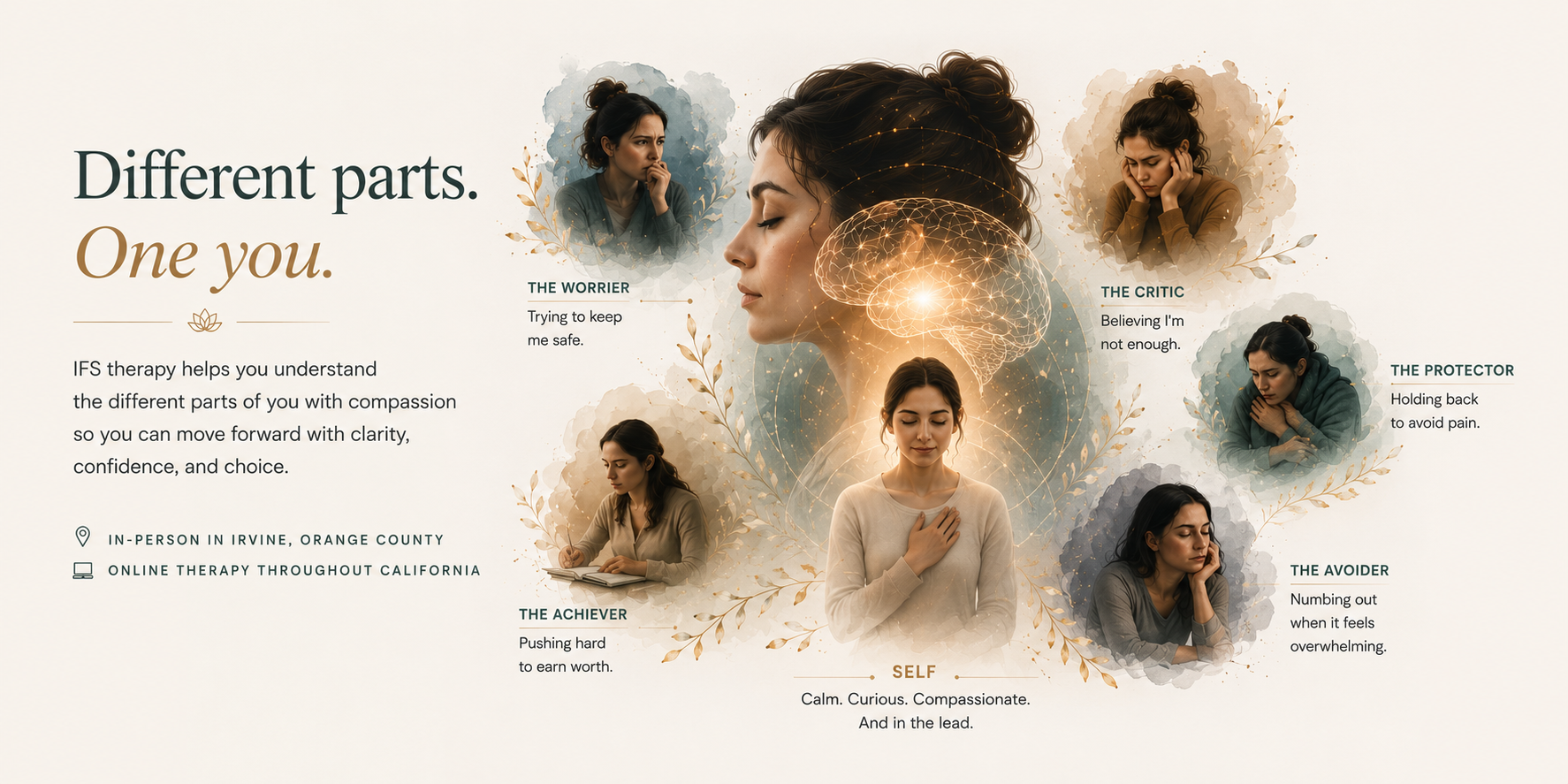
IFS recognizes something most of us experience naturally: different aspects of us can think, feel, and want very different things at the same time.
Part of you can want intimacy while another fears depending on anyone.
Part of you can know you should leave while another desperately wants to stay.
Part of you can want success while another procrastinates when an opportunity makes you visible.
IFS refers to these different internal experiences as parts.
Rather than treating these parts as irrational or trying to eliminate them, we become curious about what they are trying to accomplish.
Some parts work hard to prevent pain. Others carry more vulnerable emotions, memories, fears, or beliefs about what you must do to be loved, accepted, safe, or enough.
The goal isn’t to get rid of parts of yourself.
It is to understand your internal system differently so that old protective strategies don’t have to make today’s decisions for you.
You don’t need to know IFS terminology before beginning. You can simply come in saying:
“I understand why I do this. I just don’t know how to stop.”
We can start there.
My Approach:
IFS-Informed and Attachment-Focused
EMDR:
IFS helps us understand the protection.
What part of you is responding? What does it fear? What does it believe would happen if it stopped doing its job?
Attachment helps us understand the relational map.
What did earlier experiences teach you about love, closeness, rejection, vulnerability, safety, worth, and belonging?
What became familiar enough that your emotional system may continue recreating it—even when your adult mind wants something different?
EMDR helps us work with what may still be emotionally encoded.
What experiences, memories, emotions, sensations, or negative beliefs continue to feel true despite what you consciously know today?
For example, your adult mind may genuinely believe:
“I don’t have to earn love.”
But when someone becomes distant, another response emerges:
Try harder. Don’t ask for too much. Make them choose you.
Instead of only challenging the thought, we can understand the protection around it, explore the attachment experiences connected to it, and, when appropriate, use EMDR to work with experiences and beliefs that may still be shaping the present.
IFS helps us understand the protection.
Attachment helps us understand the relational map.
EMDR helps us work with what may still be emotionally encoded.
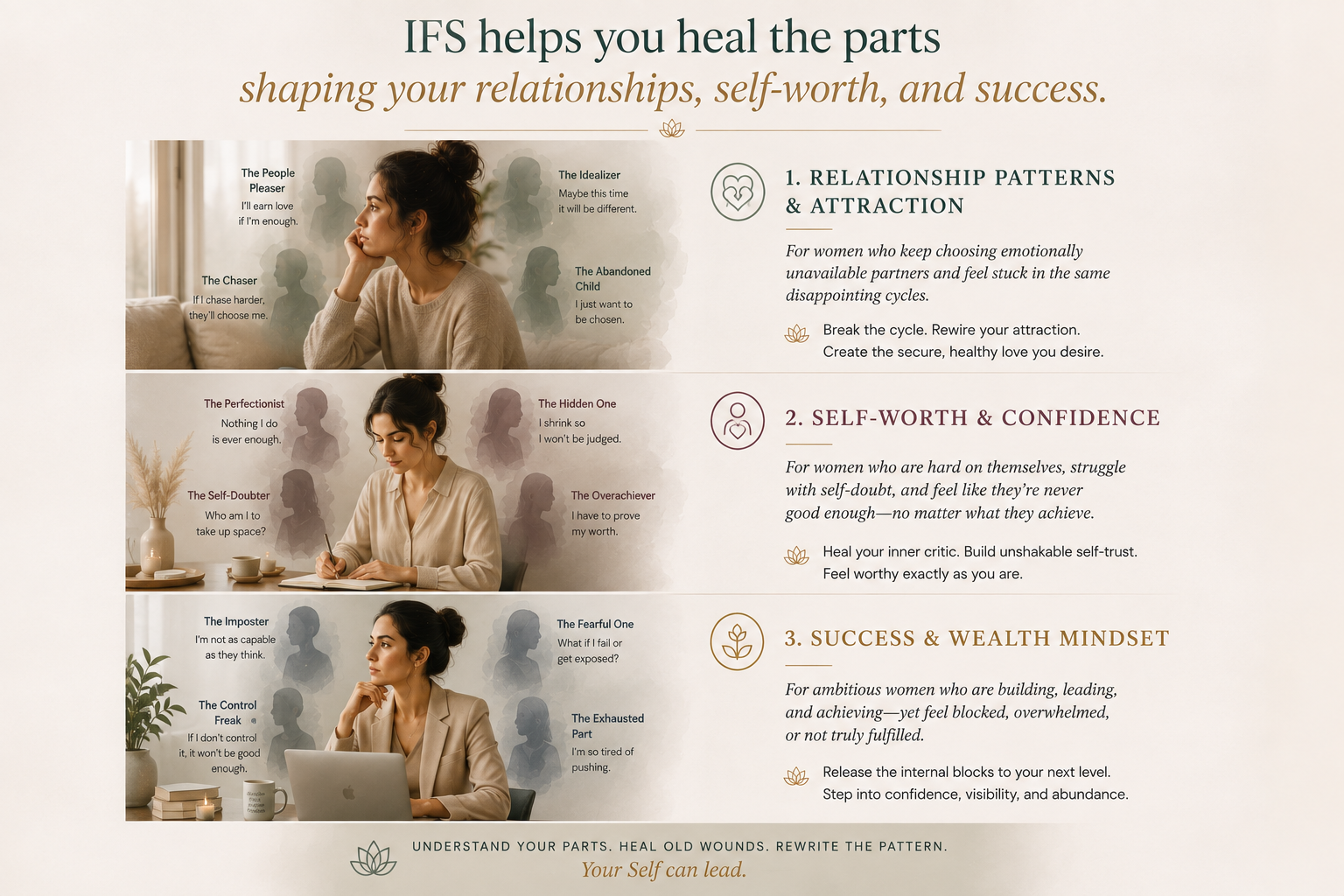
“Why Do I Keep Wanting People Who Can’t Give Me What I Need?”
You may know exactly what a healthy relationship should look like – consistency, availability, mutuality, respect – and still feel most intensely drawn to people who are difficult to reach.
Maybe someone’s distance makes you want them more.
Maybe inconsistency feels exciting while steadiness feels strangely unfamiliar.
Maybe you know you shouldn’t have to chase someone, yet uncertainty makes it harder to let go.
I’m less interested in simply telling you to “choose better.”
You probably already know that.
I’m interested in understanding why this particular relationship dynamic has so much emotional power for you.
Sometimes the part chasing another person isn’t only chasing the person. It may also be chasing what finally being chosen would seem to prove:
I am enough.
I am lovable.
I matter.
I was worth staying for.
IFS and attachment-focused therapy allow us to explore what your emotional system may have learned to associate with love, attraction, pursuit, safety, and worth, so we can work with the pattern rather than simply judging it.
“Why Don’t I Trust Myself Anymore?”
Emotionally or narcissistically abusive relationships can affect more than how you feel about another person.
They can disrupt your relationship with yourself.
You may leave the relationship and still question your perceptions, minimize what happened, struggle with boundaries, miss the person who hurt you, or wonder whether you were actually the problem.
One part may know exactly what happened.
Another may still love them.
Another may blame you for staying.
And another may decide:
“I’m never letting anyone close enough to do this to me again.”
My doctoral research focused on clinician recommendations for survivors of narcissistic abuse, and this remains an important area of my clinical work.
Our work can move beyond analyzing the former partner and toward rebuilding self-trust, identity, discernment, boundaries, confidence, and your ability to remain connected to yourself within future relationships.
Learn about Narcissistic Abuse Recovery
“Why Don’t I feel Good Enough for my big dreams and goals?”
You can have the education, career, business, accomplishments, and plenty of evidence that you’re capable—and still have a part of you saying:
Not enough yet.
For high-achieving professionals and entrepreneurs, some of the strategies that helped create success can eventually become exhausting.
Perfectionism may protect against criticism.
Overachievement may help you feel valuable.
Self-criticism may believe that if it stops pushing, you’ll stop succeeding.
Procrastination may appear precisely when an opportunity matters enough that failure—or visibility—feels threatening.
And each new accomplishment may provide relief only until the goalpost moves again.
I am not interested in making you less ambitious.
I’m interested in whether your ambition can increasingly come from desire, purpose, confidence, and choice rather than fear, shame, or a constant need to prove your worth.
Explore therapy for Self-Doubt & Confidence
 Why Work With Dr. Sadaf Shalchian?
I am Dr. Sadaf Shalchian, DMFT, LMFT, a Doctor of Marriage and Family Therapy, California Licensed Marriage and Family Therapist, and founder of Akoya Wellness & Counseling Services in Irvine, California.
I have completed Level 1 training in Internal Family Systems (IFS) and integrate IFS principles with attachment-focused psychotherapy, EMDR therapy, and EMDR Intensives.
My work focuses particularly on repeating relationship and attraction patterns, attachment wounds, recovery after narcissistic or emotionally abusive relationships, self-worth, perfectionism, chronic self-doubt, imposter syndrome and internal barriers experienced by ambitious professionals and entrepreneurs.
Across these concerns, I am interested in a deeper question:
What did you learn about yourself, relationships, love, safety, worth, or success that may still be shaping your choices today?
Learn more about Dr. Sadaf Shalchian
Want More Focused Time Than Weekly Therapy Allows?
I also offer IFS-informed EMDR Intensives for clients who may benefit from longer, concentrated blocks of therapeutic work around a defined experience, belief, or recurring pattern.
Depending on your needs, intensives are available in half-day, full-day, and multi-day formats.
I also provide adjunctive EMDR Intensive work for appropriate clients who already have a primary therapist. With authorization, I can collaborate with your existing therapist while focusing our intensive work on a specific target.
You don’t need to determine on your own whether weekly therapy or an intensive is right for you. We can discuss the most appropriate format during your consultation.
Frequently Asked Questions
Are you an IFS therapist in Irvine?
Dr. Sadaf Shalchian, DMFT, LMFT has completed Level 1 training in Internal Family Systems and provides IFS-informed psychotherapy through Akoya Wellness & Counseling Services in Irvine, California.
What is attachment-focused, IFS-informed EMDR?
It integrates three complementary perspectives: IFS helps us understand protective and vulnerable parts; attachment-focused work explores how relational experiences may influence present patterns; and EMDR can be used to work with experiences, emotions, memories, sensations, and negative beliefs connected with those patterns.
Can IFS and EMDR be used together?
Yes. IFS principles can be integrated into EMDR treatment. This can include understanding protective responses that emerge around an EMDR target rather than simply trying to push past them. EMDRIA itself offers professional education specifically on integrating IFS with EMDR.
Can this approach help with repeating relationship patterns?
IFS and attachment-focused therapy can help us explore the protective responses, relational learning, and beliefs that may contribute to repeatedly becoming attached to unavailable or inconsistent partners. Therapy cannot guarantee who you will be attracted to, but it can help you understand and work with the patterns influencing your choices.
What if I’ve already been in therapy and understand my patterns?
You are not starting over. Previous insight can be valuable. This approach may be particularly relevant when you understand a pattern intellectually but notice that your emotional reactions have not changed in the same way.
Do you offer online IFS-informed therapy throughout California?
Yes. I provide in-person psychotherapy in Irvine, Orange County, and online psychotherapy for adults located throughout California.
You Don’t Have to Keep Fighting the Pattern Without Understanding What It’s Protecting.
The part that chases.
The part that pulls away.
The part that overachieves.
The part that procrastinates.
The part that needs reassurance.
The part that still doesn’t believe you’re enough.
These responses didn’t appear out of nowhere.
Understanding what they are protecting, and working with what may be underneath them, can offer a different path than spending another year trying to reason yourself out of reactions that don’t feel rational in the first place.
If you’re ready to work more deeply with the patterns shaping your relationships, self-worth, confidence, or success, I invite you to schedule a consultation.
Dr. Sadaf Shalchian, DMFT, LMFT
Akoya Wellness & Counseling Services
In-person in Irvine, Orange County | Online throughout California
The Latest from our EDMR Blog

Healing Attachment Wounds to Improve Dating & Relationships with EMDR Intensives
Heal attachment wounds with EMDR Intensives and transform your relationships. Follow Leilani’s journey of overcoming self-doubt to embrace connection, self-worth, and love.

EMDR Intensives: A Path to Healthy Relationships
Discover how EMDR Intensives can transform your relationships and self-worth by helping you release limiting beliefs and past traumas. Follow Sarah’s journey from self-doubt to a fulfilling, healthy relationship, and learn how EMDR can be a powerful tool for creating lasting change.

EMDR Intensives: Unlocking Career Goals and Financial Success
Discover how EMDR Intensives can help unlock your career and financial potential by breaking through self-doubt and limiting beliefs. Follow James’s journey as he overcomes professional barriers, paving the way to success through the transformative power of EMDR therapy.